CNET Interviews Colin Angle Of iRobot

Writing by Evan Ackerman on Thursday, 16 of April , 2009 at 5:03 am

iRobot Logo

CNET got a chance to sit down with Colin Angle, CEO of iRobot, and asked him a bunch of questions ranging from military robots to consumer robots to robot ethics to why humanoid robots are largely a waste of time. I’ve quoted some of the most interesting (IMO) passages here and after the jump; you can read the entire interview over on CNET.

The Roomba is still the center of focus for iRobot?

Angle: The Roomba is certainly the largest revenue driver at this point. It has a head start, it was the first thing that we did, and while the brand iRobot entrusts that the products we make are truly practical–they’re not gimmicks and actually work– that helps the subsequent products come up quicker. The Roomba still has a relatively tiny penetration–we’ve sold over 3 million of these robots. It sounds like a big number, and it is, but compared to the number of households in America, it’s a tiny number.

Our users are very passionate about the product, they tell their friends and so forth. We’ll continue to see, just driven by our installed base, more people, more success, driving more Roomba sales, and then with sales of the other products moving along nicely, but still in the shadow.

We keep at it. We’re not done. The mission of the division is to keep working at robots that will help tackle the dull, the dirty, and the dangerous–the routine maintenance tasks that we’re faced with, and once we’re done with that, trying to turn our focus to the people who live in the homes and with this notion of helping people live more easily, more independently. It’s early days. You know, we can vacuum. We can vacuum well, and scrubbing is coming along and so forth. But there’s so much more a robot could do as far as helping you come home to a house that is exactly the way you want it, with no need for you to go and do these maintenance types of tasks.

What would be the next thing to tackle?

Angle: Well, we don’t actually talk about what we’re doing next. It’s sort of, in the future here’s the body of things.

Still no lawn mower.

Angle: There’s the lawn mower, there’s cooking, there’s windows, there’s more stuff going on in the bathroom with your tub, and doing laundry, folding laundry, putting stuff away. Once we get manipulation on the robots at consumer price points, those are all very real, very doable sorts of things. Shoveling the driveway.

What about a humanoid robot?

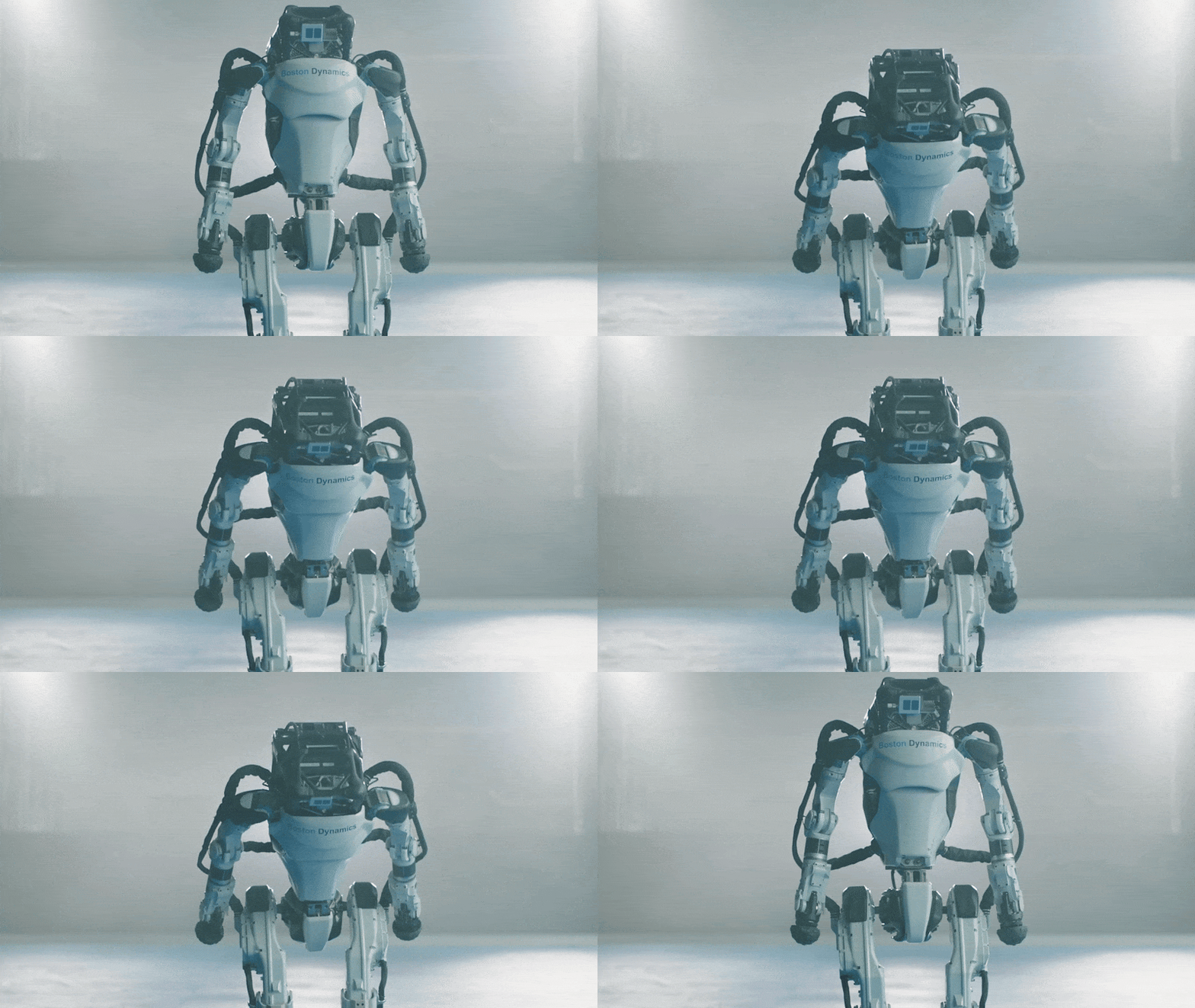
Angle: Why would you want to make a humanoid robot? I mean, I guess for making movies they’re good. If you want to have a robot companion, maybe it should be humanoid. But other than that, most tasks are best tackled by designs that are not constrained by trying to look like a person. I mean, balance and walking are incredibly hard things to do. If you look at some of the Japanese walking robots, because they’re very focused on solving this problem, and then compare it to Warrior, our large, dual-track system, and say, OK, which one makes more sense?

The Asimo (from Honda) requires a team of 10 or 15 people to maintain it, it can walk about, maybe, half a meter per second and in some situations climb stairs over the course of a few minutes, and if it ever falls down, it’s a paperweight. I think it has something like 40 or 50 motors in order to make it work. Then take the Warrior, and the Warrior can take a 10-foot drop onto concrete, drive 20 miles an hour, drive up stairs without stopping at full speed, carry 200 pounds of payload and has, maybe, five motors. So it’s stronger, it’s faster, it’s more durable, it has more efficiency, and it can go nearly everywhere a human can. So you look at these things and say, which one of these is a robot human? The answer is, Warrior. Warrior is designed to operate in environments that we have designed for ourselves, as efficiently and capably…

Some people, including (author) P.W. Singer, have raised the issue of battlefield ethics, the laws of war, and how robots might change that. How do you see the use of robots reshaping combat?

Angle: There is always going to be, at least for a long time to come, a human in the loop, as far as trying to decide when a robot should employ lethal force. You know, AI is not to the point where a machine should be making a life-or-death decision, and I wouldn’t even be able to tell you when I thought that might actually come to pass.

But what a robot does give a soldier is the ability to shoot second–which is, again, incredibly empowering and important. Let the robot be the thing on the point, let someone attack it, and by doing so reveal his position and reveal the intent of what they’re doing there. This is a big, big concept–robots let the soldiers shoot second. Additionally, a robot can carry nonlethal technologies, where a soldier is much, much less willing to do so. If a bad guy’s over there with an AK-47, I want my M-16, I want my machine gun.

(Robot technology) is something that you need to be very careful of. It also offers some of the best hope for humanely dealing with this new type of bad guy that we’re faced with.

[ CNET ] VIA [ Engadget ]

Leave a comment

Category: Consumer

No Comments

No comments yet.

Leave a comment

XHTML: You can use these tags: <a href="" title=""> <abbr title=""> <acronym title=""> <b> <blockquote cite=""> <cite> <code> <del datetime=""> <em> <i> <q cite=""> <strike> <strong>

What Is BotJunkie?

From the folks who brought you OhGizmo.com, BotJunkie obsessively chronicles Man's inevitable descent into cybernetic slavery.

One robot at a time.