BotJunkie is merging with Automaton to form the best robotics blog on the Net! Please continue
following our stories at our new home and update your RSS reader with our new feed. See you there!

ECCEROBOT Mimics Humans, Inside And Out

Writing by Evan Ackerman on Monday, 17 of August , 2009 at 3:42 am

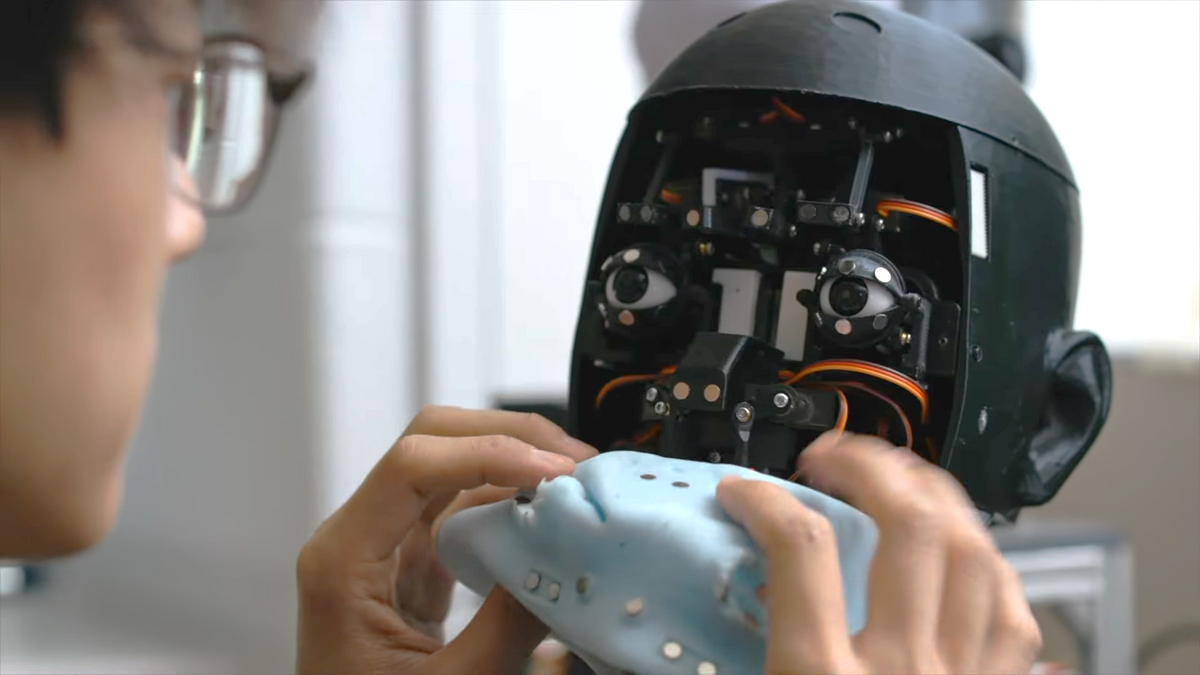
This is ECCE, an anthropomimetic robot designed to test embodied cognition in compliant engineering. In other words (normal words), it’s a robot designed to emulate a human, both inside and (eventually) out, the idea being that this will make the robot more human-like. ECCE uses artificial bones, muscles, and tendons, all wired together in the same way that yours are, in the hope that the robot will be able to move less artificially.

“Standard humanoid robots mimic the human form, but the mechanisms used in such robots are very different from those in humans, and the characteristics of the robot reflect this. The concept of anthropomimetic robots, such as ECCE, will compensate these drawbacks by not just replicating the appearance of a human, but duplicating the inner structures and mechanisms of humans.”

I’m not exactly sure what drawbacks are being referred to… Yes, robots end up being robot-like, and most anthropomorphic robots tend to strike that uncanny valley chord, at least to some extent. But I don’t think the solution is to structure robots based on humans. I mean, the whole point (okay, one of the points) of robots is that they have the capability to do things that humans can’t do, or at least can’t do very well. They’re not humans, and the most effective robots are generally the most specialized and therefore least human. Arguably, the only reason to model a robot on a human at all is that robots have to operate in a world designed by and for humans, and those humans have some hangups when it comes to interacting with things that aren’t humans. And most of the time, it’s just not worth it. As the video rightly points out, using human muscle style motors is way, way more complicated than using a servo or two. Yeah, it’s (potentially) a more “natural” motion, but who cares? You can generally emulate the same thing with some tastefully programmed servos. I would guess that with some kind of skin on, you’d be hard-pressed to tell the difference between a robot using artificial bio-inspired muscles versus a well-programmed combination of servo motors.

That said, there’s a lot to be learned about motion, and humans are as good a place to start as any. My only worry is that if you imagine the endpoint of this project, you end up with an extremely complicated robot that isn’t significantly less robot-y than a bot with more traditional innards, while sacrificing the power, speed, and precision that we’ve grown to expect from robot limbs.

[ ECCEROBOT ] VIA [ IEEE Spectrum ]

Comments (3)

Category: Androids,Biorobotics,Research

3 Comments

Comment by Alan Oursland

Made Monday, 17 of August , 2009 at 8:46 am

Yoky Matsuoka is doing research on the human hand and how to duplicate its functionality for a robot. Everything seems to be important, from the network of tendons to the shape of the bones that guide how the tendons lay.

http://neurobotics.cs.washington.edu/projects.html

Nature has had a lot of time to optimize motor control. By studying and mimicing nature, we can build more efficient robots.

Comment by Evan Ackerman

Made Monday, 17 of August , 2009 at 11:54 am

I certainly agree that the human hand is a pretty incredible piece of work; I guess what I’m saying is, is it really practical at this point to attempt to build robots to emulate that? In theory, it’s a wonderful idea, but does the incremental improvement that you get with (say) a five fingered hand that uses artificial muscles really justify the effort it takes to construct and maintain over a simple servo driven grabber that performs nearly as well? I’m pulling these numbers out of the air of course, but it’s like, you get 90% of the functionality with something 20% as complex.

Don’t get me wrong, I think ultimately, robots with biologically inspired systems are definitely the way to go. I’m just not sure that I agree that more traditional mechanical systems are necessarily at a disadvantage.

Comment by quantum_flux

Made Tuesday, 19 of October , 2010 at 12:19 am

Biology is inherently flawed because it isn’t made of metal.

Leave a comment

XHTML: You can use these tags: <a href="" title=""> <abbr title=""> <acronym title=""> <b> <blockquote cite=""> <cite> <code> <del datetime=""> <em> <i> <q cite=""> <strike> <strong>

What Is BotJunkie?

From the folks who brought you OhGizmo.com, BotJunkie obsessively chronicles Man's inevitable descent into cybernetic slavery.

One robot at a time.