Blind Juggler Robot Juggles Without Sensors

Writing by Evan Ackerman on Wednesday, 16 of September , 2009 at 3:08 am

Commenter DaveX asked about the ball bouncing robot from yesterday’s video of RoboDays 2009, and after a little digging, I was able to find out all about it. It’s called Blind Juggler, so named because it manages to juggle balls without any sort of sensors. It’s all mechanical design, and math.

I’ll do my best to explain how it works (with diagrams!), after the jump.

Ideally, designing a robot that can juggle a single ball would be a cinch… Since robots are good at precise repetitive motion, once you got the thing going in a stable manner, it would just go on forever. The problem is, of course, that nothing works out that way in real life. There are all kinds of niggling little variables that get in the way, causing systems to reliably become unstable. So how does this robot manage to pull it off? There are two simple tricks that it uses to control the two important variables in this system: the location at which the ball bounces, and the height at which the ball bounces. Keep these under control, and you’ve got a juggling robot.

Let’s start with the first one: location. Although the plate that the Blind Juggler uses to strike the ball looks flat, it’s actually slightly concave. Due to this curve, the further away from the center of the plate that the ball strikes, the higher the angle of incidence between the ball and the plate, which steers the ball back towards the center:

bounce2

Keeping the height of the ball stable works on the same general principle of mechanical feedback. As the plate moves up to strike the ball, it decelerates to a stop at the apex of its motion, before starting to move down again. If the ball is bouncing too low, it hits the plate earlier in this deceleration phase, when the plate is moving faster, meaning that the plate strikes the ball with more force, sending the ball higher. Conversely, if the ball is bouncing too high, it hits the plate later when the plate is moving slower, and the ball is struck with less force:

bounce

So, if every part of the system is working perfectly, you get a ball bouncing in the exact center of the plate, being struck at the ideal point of contact every time. And whenever some unforeseen variable (like someone moving the robot) causes the ball to stray a little bit, the design of the system itself works to move everything back to a stable point. It’s really quite beautiful.

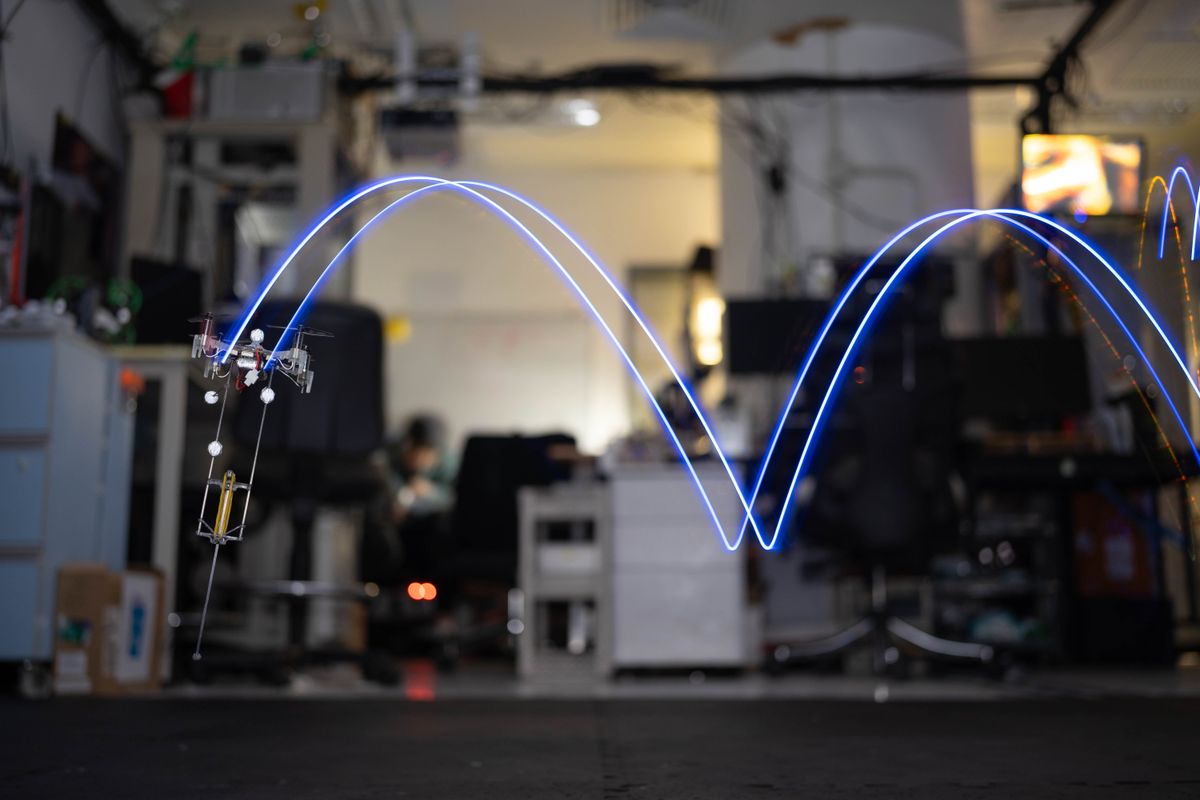
This is the next step: a stable pendulum juggler. Currently it can juggle at a maximum amplitude of 15 degrees, but they’re working on getting it up to 30.

[ Blind Juggler ]

Comments (2)

Category: Research

2 Comments

Comment by puneet

Made Wednesday, 16 of September , 2009 at 3:58 am

awesome and simple design

Comment by DaveX

Made Wednesday, 16 of September , 2009 at 9:47 am

As a total math-phobe, I have to say that I’m more than a little frightened of this thing. Still, it’s super-interesting. What’s the application for this, though?

Leave a comment

XHTML: You can use these tags: <a href="" title=""> <abbr title=""> <acronym title=""> <b> <blockquote cite=""> <cite> <code> <del datetime=""> <em> <i> <q cite=""> <strike> <strong>

What Is BotJunkie?

From the folks who brought you OhGizmo.com, BotJunkie obsessively chronicles Man's inevitable descent into cybernetic slavery.

One robot at a time.