Writing by Evan Ackerman on Monday, 21 of December , 2009 at 2:38 am
YouTube user Paxshikai is the proud owner of what is potentially the most dangerous i-SOBOT ever, thanks to its arsenal of custom made weapons that includes crossbows, sniper rifles, machine guns, rocket launchers, and even a light saber. In celebration of his 100th (!) YouTube video of an i-SOBOT blowing things up with a variety of weaponry (or doing other weird stuff), Paxshikai put together this compilation video. I don’t know how he keeps coming up with inspiration for these vids, but I have no doubt that we’re going to see another hundred (or so). I mean, i-SOBOT has to work his way up to firing a little miniature custom made tactical nuclear warhead, and for obvious reasons, that video will most likely be the last.
Writing by Evan Ackerman on Monday, 23 of November , 2009 at 1:09 am
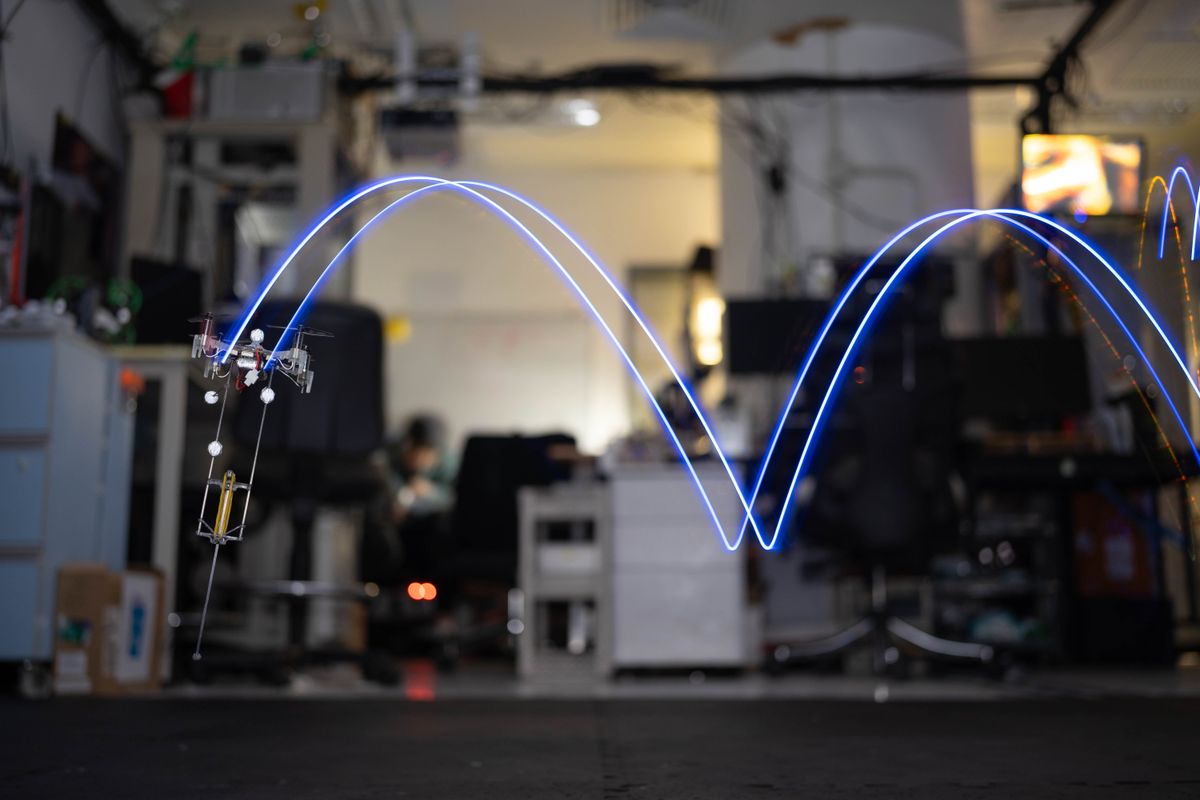
SensorFly is a prototype for what will eventually be an entire swarm of autonomous mini helicopters that can navigate, talk to each other, and carry sensors (including a miniature camera and microphone) to perform tasks like locating survivors after a disaster. Each robot weighs only 29 grams, but they’re remarkably resilient, able to handle collisions with walls as well as swats from vicious racket-swinging grad students.
Writing by Evan Ackerman on Wednesday, 28 of October , 2009 at 1:53 am
Giant mechanical soldiers?! THIS TOTALLY IS SCIENCE FICTION. And furthermore, after you say something like that, you do NOT then present your actual product as a computer generated model.
If REX actually exists (and developer Israel Aerospace Industries insists that it does), it’s a little six wheeled robotic platform able to carry 200 kg on missions for 72 hours without needing to refuel. This is kind of like a miniature version of Lockeed Martin’s MULE, except that it’s about as user friendly as a well-trained dog: Rex will follow the lead soldier of a group automatically and responds to commands like “stop,” “heel,” “fetch,” and “roll over.”
Okay, maybe not that last one, but it does (somehow) fetch.
IAI is optimistic that there is a significant market for a low cost, reliable, and versatile robotic hauler. And I’m sure there is. I’ll tell you what, though: I bet there’s an even more significant market for a GIANT MECHANICAL SOLDIER.
Writing by Evan Ackerman on Monday, 28 of September , 2009 at 12:54 am
This is SAMARAI, a UAV that Lockheed Martin has been working on based on a monocopter platfor. A monocopter is like a helicopter, except that the entire vehicle consists of a single rotating airfoil, making them somewhat impractical for manned flight. And, from the looks of things, more than a little dangerous, although the project was named SAMARAI not after its efficiency at decapitations but after samara, which are those monocopter seed pod things that fly down off of trees.
Eventually, the SAMARAI project was supposed to produce a nanomonocopter (?) about the same size as a seed pod (on the order of 1.5 inches long and 10 grams in weight), driven by a miniature rocket or jet thruster, able to send back streaming video (that was stabilized somehow), autonavigate, and deliver a 2 gram payload up to a kilometer away. The big version in the video above was a testbed to help engineers figure out just how to get this thing to fly in a stable and controllable manner.
Now, I’m not entirely sure what’s going on with this particular project… According to Danger Room, the SAMARAI project was canceled last year after completing phase 1 of a DARPA nano air vehicle contract. Phase 2 of that contract, incidentally, went to AeroVironment for this. The information included with the above video, however, suggests that this flight test is “recent,” and while no sources are cited, the YouTube channel it’s from is run by an editor over at Aviation Week (or so it says), so there’s some amount of credibility there. Maybe we’ll get some answers in the near future now that this video is live.
After the jump, an unrelated but extremely scary video of an uncontrolled monocopter powered by 3 model rocket engines firing in sequence (Read more…)
Writing by Evan Ackerman on Friday, 20 of March , 2009 at 2:33 am
Flickr user Photo David has a nice set of pictures of a miniature Wall-E figurine in a variety of adorable situations. I think you can get the entire set of figures at ThinkGeek. A couple more pics, after the jump. (Read more…)
Yatter-Bark: This dog-shaped robot was designed by Gan’s father as a prototype rescue robot, but was never constructed. It is finally completed by Gan in the first episode and is immediately put into action against the Dorombo gang. It is fitted with a siren and a bell like other rescue vehicles, and also a joystick (all of these are operated by the robot itself) which control the various other features of the robot. Unlike the “time bokan” series of time machines in the original show, it does not provide a cockpit for the crew–the robot is clever enough to obey the words of the Yatterman duo, who simply hang on to its sides.
The robot itself does not pack much of a punch in terms of combat strength (save for its nostrils which fire iron pellets, and the two firehoses on its back). In fact, it is often temporarily defeated each time by the villains’ mecha in later episodes. One element, though, remains the key feature to the heroes’ turning point: a bone-shaped power pack, known as “Mecha-Tonic” as Gan has named it, is usually fed to the dog robot on its very point of total defeat, allowing a sudden outburst of strength to ward off a deadly blow from the enemy mecha. It will then proudly announce (with the aid of three tiny dog-shaped robots popping out of its chest and do a drum roll) and perform its special attack–a large group of miniature robots, usually taking the shapes of land-based animals, that comes out of its mouth. Then these mini-robots will attack the Dorombo’s mecha by taking it apart piece by piece with their concealed weapons, causing the enemy’s mecha to explode spectacularly, leaving just pieces of scrap metals, and a very dirty, tattered villain trio behind.
I don’t get it at all, but the live action movie has already been released in Japan.
Writing by Evan Ackerman on Tuesday, 24 of February , 2009 at 12:19 am
Speaking of makers and DIY robots, Make Magazine has posted a video tutorial on how to make yourself some very basic bots, including vibrobots, a junkbot made out of a tape player, and an insect bot that uses feelers to avoid obstacles:
If you liked any of these but don’t want to have to scrounge for parts yourself, I highly recommend getting a solar bugbot kit. I put one together myself in a few hours, having never soldered anything before, and it was a lot of fun… You can read my review (with video!) here.
Writing by Evan Ackerman on Friday, 26 of September , 2008 at 5:21 am
Here’s an excellent way to waste a few minutes of your Friday: take remote control of an unmanned ground vehicle in Australia. BP has set up a miniature course shaped like the fine country/continent of OZ, and stuck five little Surveyor robots (which you can get for yourself here) inside. The robots are controlled wirelessly over the internet by you via a Flash interface, and stream video from front-mounted cameras to let you see where you’re going. You only get 4 minutes at a time, and the bots only seem to operate between 9am and 9pm GMT+10 (whenever the heck that is), but so far I’ve always been first in line and have never had to wait my turn. Codes are hidden around the course that you can use to give yourself more drivin’ time, but I was entertained enough just exploring the city and outback areas and trying to get my little robot to drive over a bridge.
Oh yeah, and the bots are 100% solar powered, go BP!
Writing by Evan Ackerman on Wednesday, 5 of December , 2007 at 4:21 am
Most of the time, armed military robots don’t phase me that much. I mean, I can understand why they’re useful and important and generally a great idea when it comes to protecting living people. But, I’m starting to wonder if I’m deluding myself after watching this video of a concept armed rover from Robotex:
The video makes it quite obvious that this robot is designed to kill people, and do it efficiently. It’s pretty scary, if you ask me. Of course, robots like TALONSWORDS are designed to do the same thing, but the designers of those robots have chosen to emphasize both versatility and safety, while the Robotex bots do only one thing. This, incidentally, makes them about 1/6 the cost of the TALON system at between $30,000 and $50,000 each. The Robotex system currently on the market (in the pics above) mounts an $8,000 Atchisson Assault-12 shotgun, which “delivers the lead equivalent of 132 M16s. … [The robot is] two feet tall, travels ten miles an hour, and spins on a dime. Remote-controlled over an encrypted frequency that jams nearby radios and cellphones, it’ll blow a ten-inch hole through a steel door with deadly accuracy from 400 meters.”
As if that wasn’t enough, part of the system includes semi-autonomous Neural Robotics miniature helicopters, also outfitted with automatic shotguns:
I think what bothers me about all this is not the robots themselves; rather, it’s the fact that the people marketing these robots have one thing on their minds: selling armed robots to kill people and make money. Whether or not this is (in general) a good thing or not is debatable, and whether or not other companies developing armed robots are doing effectively the same thing (just less bluntly) is also debatable.
Like it or not, I can’t help but be certain that this is the future of the military.
Writing by Evan Ackerman on Friday, 28 of September , 2007 at 3:06 am
At 1/4 cubic inch in volume and a weight of less than 1 ounce, these mini-robots being developed by Sandia National Labs may be some of the smallest autonomous untethered robots in existence. They’re powered by 3 watch batteries, and have tracked drive systems, an 8K ROM processor, a temperature sensor, and optionally a miniature camera, microphone, communication system, and chemical micro-sensor. The bodies of the robots are created through rapid-prototyping and are mostly constrained by the size of the batteries required to power them (meaning that they’ll shrink further with improvements in battery technology). With a top speed of only 20 inches per minute, each bot may not be able to get very far very fast, but they’re designed to be used in swarms to accomplish larger and more complex tasks. Video of the mini-bot driving over loose change after the jump. (Read more…)