LittleDog Clips And Outtakes

Writing by Evan Ackerman on Monday, 21 of September , 2009 at 1:31 am

littledog_36_web

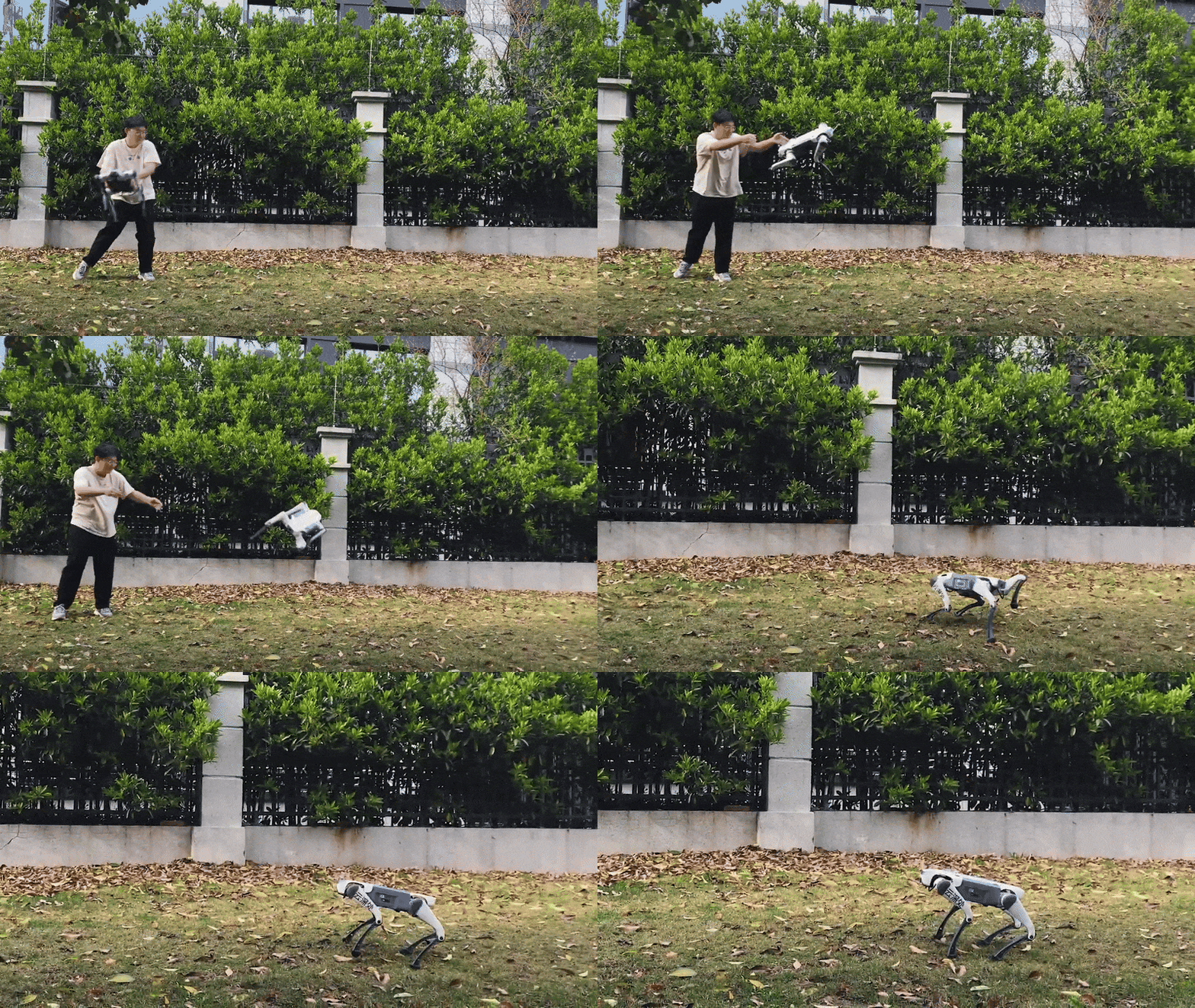
Browsing around the MIT website (as I do from time to time so that you don’t have to), I ran across the web page of Katie Byl (that’s “bill”), who is currently working at the Harvard Microrobotics Lab (on stuff like this). Katie used to study legged locomotion at MIT, which involved developing dynamic motions for LittleDog. And sometimes, these motions didn’t quite work out as planned… Also in the following video are clips of LittleDog walking on pegs (“Karate Kid” style), and a slow motion clip of LittleDog bounding up onto terrain:

Incidentally, the reason why LittleDog collapses the way it does is that DARPA gives points for LittleDog’s speed (irrespective of whether it’s upright or not), and LittleDog can increase its speed over a given distance slight by collapsing forward and then stopping the clock. Katie calls this a “dramatic death-dive.” Dramatic indeed.

[ Robot Locomotion @ MIT ]
[ Katie Byl @ MIT ]

Comments (5)

Category: Biorobotics, Humor, Research

LittleDog: Locomotion Research Is Exhausting

Writing by Evan Ackerman on Tuesday, 8 of September , 2009 at 3:03 am

Researchers at places like MIT have been using Boston Dynamics‘ LittleDog robot for years now as a testbed to teach legged robots to learn how to traverse variable terrain on their own. This video shows some highlights of a “dynamic double-support gait,” which means (as near as I can tell) that LittleDog is supporting itself, at times, on only two of its four legs. This is a substantially more efficient way of negotiating terrain than we first saw two years ago. LittleDog also demonstrates some markedly biological ways of negotiating obstacles (with the possible exception of the belly flop on the Jersey barrier)… I especially liked how it pranced in place slightly before tackling each stair. All this stuff is obviously a lot of work for a little bot, since poor LittleDog completely collapses at the end of every test.

LittleDog, remember, is teaching itself the most efficient way to negotiate these surfaces. Overhead cameras examine the terrain and plan out LittleDog’s route by computing a ‘cost’ for each step, which takes into account the distance moved towards the goal as well as the potential for a fall. After a lot of trial and error, LittleDog figures out how to best compromise between progress and stability, and the lessons it learns could be propagated up to other, larger quadruped robots.

This video is from Phase 2 of DARPA’s Learning Locomotion program… MIT’s LittleDog team was awarded funding for Phase 3 of this program back in 2008, so we’ll keep you updated.

[ MIT Robot Locomotion Group ]
[ 2006 Abstract ]

Comments (3)

Category: Artificial Intelligence, Biorobotics, Research

LittleDog Navigates Ruff Terrain

Writing by Evan Ackerman on Tuesday, 18 of September , 2007 at 5:23 am

LittleDog

By Evan Ackerman

Robots are notoriously bad when it comes to the unpredictable. This is unfortunate, since most of the environments on Earth are more or less unpredictable. Professor Stefan Schaal from USC Viterbi is attempting to build a robot dog that can autonomously navigate over very rough terrain, and has received $1.5 million from DARPA’s Learning Locomotion program in order to do so. DARPA is interested because a pack of robot dogs would be great at carrying supplies for troops, as long as they’re capable of keeping up on their own. Currently, they have large dogbots in active development that can handle flats and ramps, but nothing more challenging.

Schaal’s LittleDog is designed more as a software and sensor research platform than to be a hardware prototype for DARPA. LittleDog itself is built by Boston Dynamics, and is fairly complicated. Each of LittleDog’s legs is powered by three electric motors, giving them a lot of flexibility. Sensors measure the angles of each joint as well as body orientation and foot/ground contact. The basic strategy for walking over both smooth and rough terrain is “to adjust a smooth walking pattern generator with the selection of every foot placement such that the center of gravity : follows a stable trajectory. To do this, the robot calculates where and how it should proceed, based on the current position, velocity, and acceleration of its legs. If one effort fails, the dog learns from its mistakes and tries another route the next time.”

There are two clips below; the first is an earlier (wired) version of LittleDog dealing with some pretty rocky terrain, and the second clip shows a wireless (and noticeably more evolved) version.

[ Little Dog ] VIA [ USC Viterbi ]

Leave a comment

Category: Research

What Is BotJunkie?

From the folks who brought you OhGizmo.com, BotJunkie obsessively chronicles Man's inevitable descent into cybernetic slavery.

One robot at a time.