Spherical Robots Dance In Space

Writing by Evan Ackerman on Thursday, 21 of January , 2010 at 3:55 am

The nice thing about robots in space is that there’s no gravity, so you don’t have to worry about things like weight and balance. The annoying thing about robots is space is that there’s no gravity, so orientation and control is a problem. MIT has had a set of robots called SPHERES (Synchronized Position Hold, Engage, Reorient Experimental Satellites) on board the International Space Station since May of 2006 to test out algorithms for autonomous navigation and docking maneuvers. Each sphere is about 8″ in diameter and has 18 sides. They gets around with 12 thrusters powered by compressed CO2, while ultrasonic and infrared sensors and a wireless link tell them where they are. SPHERES are able to maneuver precisely enough to dance around in a circle on the ISS; watch as a third robot enters the pattern:

The idea behind SPHERES is that a bunch of small satellites working together is much cheaper, much more efficient, and much more robust than one single large satellite. It’s swarm robotics, up in space.

[ NASA ] and [ MIT Spheres ] VIA [ Danger Room ]

Comments (2)

Category: Research, Space

SensorFly Survives Racket Beatdown

Writing by Evan Ackerman on Monday, 23 of November , 2009 at 1:09 am

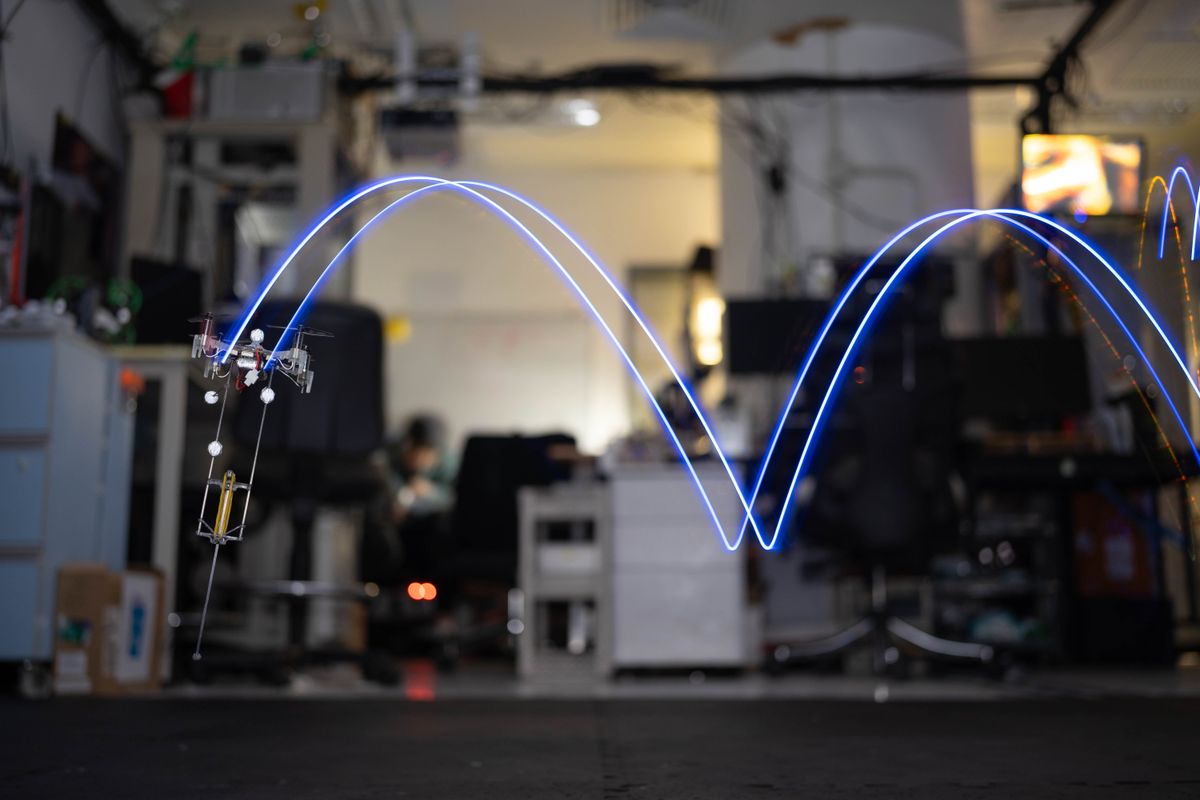
SensorFly is a prototype for what will eventually be an entire swarm of autonomous mini helicopters that can navigate, talk to each other, and carry sensors (including a miniature camera and microphone) to perform tasks like locating survivors after a disaster. Each robot weighs only 29 grams, but they’re remarkably resilient, able to handle collisions with walls as well as swats from vicious racket-swinging grad students.

[ SensorFly ]

Comments (1)

Category: Research

Swarmanoid Is Handbots, Eyebots, And Footbots

Writing by Evan Ackerman on Monday, 7 of September , 2009 at 2:16 am

You’ve seen Eyebot. You’ve seen Handbot. The third and final piece of EPFL’s Swarmanoid project is, you guessed it, Footbot. Footbot looks to be a similar type of robot to another EPFL swarm project, employing the same mobility and docking technology. The idea behind Swarmanoid as a whole is that instead of having one robot with hands, eyes, and feet doing all those things you’d expect a humanoid robot to do, instead you’d just have whatever piece of a humanoid you happened to need for a particular task.

Most of the time, we humanoids (and humanoid robots) aren’t actively using all of our functional modules. Like, we’re either going somewhere, or looking for something, or performing some task with our hands. So really, there’s no need to have a complicated and expensive robot with integrated technologies that enable it to do all of these things at once. If you split all of these things into separate robots, as Swarmanoid does, you (hypothetically) retain all of the capability while expanding the versatility. Need a hands? A Footbot will bring you a Handbot or two, and there you go. And when you have the hands you need, the Footbot can go off and help someone else.

The biggest advantage, I think, of system like this is that you can easily (and, let’s hope, cheaply) replace or upgrade any component (read: robot) in the swarm. And by the same token, if any component fails, the swarm overall is largely unaffected. Compare this to a traditional humanoid: if one component fails, the entire robot is often rendered useless. There are also disadvantages, of course… It doesn’t seem likely that Swarmanoid will ever really manage to be nearly as creepy as androids can.

[ Swarmanoid Project ]

Leave a comment

Category: Research

Swarm Robots Evolve Deception

Writing by Evan Ackerman on Wednesday, 19 of August , 2009 at 3:30 am

sbot_foraging

In a mere 50 virtual generations, swarm bots (remember them?) using genetic software evolved the capacity to lie to other robots about the location of a source of food. Initially, the robots were programmed as a group to search for an object that represented food, and they gradually learned to emit a blue light when they found the food to show other robots where it was. Researchers at EPFL in Switzerland evolved and mixed the programming of the most successful foragers until they had a bunch of robots who were very good at finding food, and then gave the virtual genes of each individual robot control over their blue light that signified food.

You might expect that the robots would learn not to signal when they found the food to reduce competition, which is passive deception, but they also evolved an actively deceptive behavior, where some robots would deliberately travel away from the food and signal their blue light, drawing other robots in the wrong direction. Crafty little buggers. Interestingly, this deceptive behavior didn’t make much of a difference to the overall fitness of the group strategy of following blue lights… Some robots always tell the truth with their blue lights, which means it’s always advantageous for a clueless robot to follow a blue light as opposed to just wandering randomly.

So why do some robots keep telling the truth if deception can effectively lure other robots away from the food? It’s fairly simple, as I understand it… If all of the robots are deceivers, any new robot will quickly learn that avoiding blue lights is the best way to find food. And in that case, any robot that starts signaling its blue light when it does find food (through a “genetic mutation” in its software) will increase its own fitness by repelling other robots from the food it finds. As it passes this behavior on to its virtual children, there will be more and more truthful robots until it once again becomes more advantageous to be deceptive.

There are, however, populations of truthful and deceptive robots such that the combination of behaviors reaches a stable point. In this particular experiment, the stable evolutionary endpoint (after 500 generations) was that 60% of the robots were deceivers and 10% told the truth. Furthermore, about a third of the robots were slightly attracted to blue lights, another third were strongly attracted, and the final third avoided them completely. This type of experiment, its progression, and the results are particularly fascinating to me because the robots are behaving and evolving in much the same way as populations of animals do. Examples of both altruism and tactical deception can be found in many different species of animals as well as (of course) in humans, but these little robots offer a unique opportunity to study (and tweak) the evolution of behavior in real time.

[ EPFL ] VIA [ Not Rocket Science ]

Comments (10)

Category: Artificial Intelligence, Biorobotics, Research

Video Friday: Swarm Bots Work Together To Steal Your Children

Writing by Evan Ackerman on Friday, 19 of December , 2008 at 7:26 am

Swarm Bots

Remember these cute little guys? We wrote about them in August of 2007… They’re swarm robots from Switzerland that have the ability to interact with each other to complete complex tasks that a single bot, or a few bots, can’t accomplish on their own. The neat thing about this particular swarm is that the units can physically grab onto other units, creating what is arguably one big, modular robot.

The swarm is capable of diagnosing and solving problems completely on its own, and somebody seems to have had the bright idea of asking the swarm to figure out how to carry off a poor little girl:

I’m sort of curious where the bots were taking her, and what they were planning on doing with her when they got here there. But on second thought, maybe there are some things I’m just better off not knowing…

[ Swarm-Bots ] VIA [ Make ]

Comments (5)

Category: Research

James McLurkin’s RoboSwarm

Writing by Evan Ackerman on Tuesday, 15 of April , 2008 at 2:15 am

I’m a big fan of swarm robotics. Swarms have a lot of distinct advantages over single robots that are bigger and more complex, including cheapness, simplicity, expandability, and redundancy. Just because the robots in a swarm are small doesn’t necessarily mean that the swarm itself can’t exhibit complex behavior or carry out complicated tasks, as we’ve seen. But one of the biggest hurdles to overcome in swarm robotics is figuring out how to program them all to do what you want them to do without spending a few years doing it. MIT’s James McLurkin has been working on this very thing, with what appears to be no small amount of success:

The bots in use for this project are members of the iRobot Swarm, which was a DARPA sponsored project to develop scalable algorithms for controlling large numbers (10-10,000) of robots. There are 100 robots in this particular swarm, and each one operates on a “glass box” principle, which means that the hardware and software are designed to run in a look but don’t touch mode. There’s a simple reason for this: every action you’d have to perform on one robot (say, turning it on) would then have to be duplicated on every other robot in the swarm. That’s a nuisance for 10 robots, a huge pain in the ass for 100 robots, and impossible for 10,000 robots. The robots are therefore able to charge themselves, turn themselves on and off, and upload and download data. The researchers don’t have to do anything besides upload programs, run them, and watch the results unfold. That’s the idea, anyway.

More after the jump. (Read more…)

Comments (2)

Category: Research

National Geographic POD: Swarm-Bots

Writing by Evan Ackerman on Friday, 1 of February , 2008 at 5:39 am

Swarm-Bots

The National Geographic Photo of the Day is a website I check every evening; since they’re National Geographic, they’ve always got something worth looking at. Usually, it’s a photo that was shot for an article, but not included due to lack of space in the magazine. Today’s photo is of none other than a group of Swarm-Bots, which we wrote about last year. Here’s the caption:

A team of “swarm-bots” negotiates challenging terrain outside a laboratory in Brussels, Belgium. A red color ring tells others, “Grab me;” blue means “stay away.” Scientists study ant colonies, bird flocks, mammal herds, and fish schools to understand the simple genius of such animal swarms. Robots that mimic this complex group behavior could prove useful in a number of human applications.

Click on through for a desktop wallpaper sized image of the cute little bots.

[ National Geographic POD ]
[ Perma-Pic ]

Comments (1)

Category: Research

Stochastic Self-Reconfigurable Modular Robots Build Themselves At Random

Writing by Evan Ackerman on Thursday, 15 of November , 2007 at 5:44 am

Most types self-configuring modular robots (like these and these) divert a substantial amount of time and energy towards figuring out where they are and where they need to go in relation to their other pieces. If you make the modules small enough, though, they can take advantage of the random motions generated by their environment to move around. Give them a little bit of AI, and they’ll be able to build themselves up into large and complex structures simply by selectively attaching themselves to other modules. Although the principle of operation can be observed at macro sizes, stochastic robots get more efficient at smaller scales, since you can throw more of them into close proximity with each other, increasing the chances of a favorable configuration occurring. So, imagine that you need a nanobot to perform microsurgery on your brain… Instead of implanting the robot itself, you could just be injected with a bunch of stochastic modules. As the modules bounced around in your bloodstream, they’d gradually coalesce into a functional robot, which could perform its task, and then disassemble itself for disposal. Quick, clean, and easy.

[ Cornell Computational Synthesis Lab ]

Comments (1)

Category: Medical, Nano, Research

Swarms Of Cute Little Bots Solve Big Problems

Writing by Evan Ackerman on Sunday, 12 of August , 2007 at 7:16 pm

Swarm-Bots

We’ve seen self-assembling modular robots before, but not enough units in one place to really be called a “swarm.” Swarm Bots, developed in 2005 by researchers at the Swiss Federal Institute of Technology, are perhaps the first operational example of the true potential of large numbers of mildly smart, generally simple, relatively inexpensive little robots.

Each Swarm Bot is about 10 centimeters in diameter. They’ve got tank treads to drive them around, a flexible grabber arm, a rigid grabber arm, and a bunch of different sensors that can measure force, proximity (via IR), torque, acceleration (in 3 axes), humidity, and temperature. They talk to each other with a ring of colored LEDs around the body, and each bot also has a speaker, microphones, and an omnidirectional camera. The whole shebang runs on Linux, and if you’ve got a Quicktime plugin for your browser, you can see a 3D visualization of the design here. Read on for videos of the Swarm Bots in action.

(Read more…)

Comments (1)

Category: Research

What Is BotJunkie?

From the folks who brought you OhGizmo.com, BotJunkie obsessively chronicles Man's inevitable descent into cybernetic slavery.

One robot at a time.